
A Young Ambassador’s Story and Physician Assistants’ Visit

ASSADE
Utz Friends Newsletter
November 14, 2025

Dear Reader,
Welcome to the Utz Friends family! In numerous Mayan languages indigenous to ASSADE’s home country of Guatemala, including K’iche’ and Kaqchikel, the word “utz” means “good,” thus we invite you to join ASSADE as an “Utz Friend.” This newsletter is intended to keep you in the know on ASSADE’s work and its impact on the Guatemalan community. Written in collaboration with Julio, outreach coordinator of ASSADE, the public health club GlobeMed at UNC Chapel Hill publishes this piece, and we are happy to assist with any questions you may have regarding included information.
Cuídate!
Sara’s Story
A Young Community Ambassador’s Impact
The health care center of ASSADE was built towards opening access to primary health care to rural communities in the region of the Guatemalan highlands. Nevertheless, the needs confronted within the struggle are so wide, but the essence of our work is always seeking a light, a path to create service to those that because of resources the organization does not have included on a permanent basis. From ASSADE’s opening, we have learned a great lesson: even if we do not have all the resources, equipment, financial, staff, etc. needed, if there are willing hearts, you already win half of the battle.
It is within one of these needs for resources that we met Sara in 2014, a nine-year-old girl from Chicazanga, a small village located forty minutes away from the health care center of ASSADE. Sara is the second of five siblings; her mother brings Sara to consultation as she heard about the work of the organization from other neighbors in the village. The reason? Sara was born with hip dislocation, and she was having too much pain to walk and to develop her daily activities. In newborns a hip dislocation could be related to numerous elements, including congenital aspects, abnormal joint development, care during pregnancy, position of the newborn at birth, low level of amniotic fluid, family background among others, and differences in risk across generders with the incidence being 6 times higher in girls than boys.
Sara’s mother was only fifteen when she gave birth to Sara, and she had neither pregnancy control nor any newborn medical evaluation follow up, and she gave birth at her household. The mother of Sara never went to school as her parents lived in poverty conditions. During the first consultation, Sara’s mother expressed that she did not realize there was a problem until Sara started walking. San Andrés Itzapa, a municipality of the Chimaltenango department, is formed by 11 villages, the majority of which belong to the Mayan Kaqchikel ethnic group. There is no health-related governmental presence in the villages, leaving families feeling as though they do not have the chance to address conditions like Sara’s. When they arrive at ASSADE, Sara presented with a lot of pain, triggering her mother’s decision to do something about it.
One of the relevant aspects about the organization is centered on the time spent inside the clinic for each patient, as the philosophy is based on caring through a comprehensive approach addressing physical, social, cultural and emotional areas. The clinic does not have a service for major surgery, and unfortunately this type of treatment is not considered for the regional or national hospitals. So, we started a path of finding ways to see what would be the best way to attend Sara and her condition. Within such a fragile and fragmented national healthcare system, having access to healthcare has become a luxury. After contacting different nonprofits in Guatemala City, we ran out of options, so we decided to try to find a solution through private centers. We obtained a budget of about the cost of the surgery and treatment, but another challenge began.
As we got closer with Sara and her family, we found out that she was not attending school as her self-esteem was really affected due to her condition. Meanwhile, we added efforts of knocking on doors to see the possibility to get funds for Sara’s treatment. We included her in a couple of sessions to strengthen her at emotional and mental level. Around the same time, the mother received follow up in relation to what treatment holds for Sara, as a preparation for when that happens. Another important concern was the fact that Sara was not attending school, even though her mother wanted to give her the opportunity. The organization supported her during the primary level. Step by step, little by little, Sara started developing at school, enjoying this new stage of her life and suddenly those worried-sad eyes started to gain a new brightness.
After more than a year the opportunity was founded, and Sara would finally receive her surgery and treatment. She got her surgery in a private hospital in Antigua, Guatemala, and the organization was in charge of the logistics and follow up. It was necessary to allocate an area at her house because of the cold weather so she can have a comfortable space during her recovery. She often received visits from the organization to see how everything was going, and she was taken to the hospital for follow ups and other needs. Then, as part of the recovery, she needed physiotherapy. On the path, two volunteers that matched with that moment helped at the beginning with the therapy, and then she received the therapies on a regular basis through a private individual.
On the other hand, parallel to Sara’s case, the organization was working in building capacity inside communities, specifically to include young girls in the process of creating healthier spaces. Through this path a really relevant aspect arises: there are a lot of girls seeking opportunities, wishing for a different destiny, wanting to see beyond the current structure, hearts with beautiful dreams. However, without knowing how or without having an alternative, having unique gifts seeking to be developed can pose a logistical challenge. Over time, this program has focused on fostering and cultivating the opportunity for these girls to pursue their dreams. It was thanks to the need of connecting education with health care that arose Girls of Hope.
Girls of Hope is a scholarship program, supporting primary to professional formation education for girls in the highlands of the region of Chimaltenango. In Guatemala, there are two regions with the lowest school educational coverage, and Chimaltenango is one of these two. From the vulnerable context, conditions of extreme poverty, lack of educational structure to discrimination, and the path for these girls to have education are real challenges. If they have luck, girls could go to school and reach 3rd grade, but this is often the limit of their education. At the same time, a race to avoid getting pregnant during adolescence is underway. Somehow, the vulnerability builds a cage that does not allow these girls to open their wings and fly. At its core, vulnerability is a systematic construction of structures of discrimination against these communities that prevents them from accessing their most basic rights and prevents them from developing their dreams.
The good news is that Sara has progressed from primary to basic school, which was a challenge as she fought between hopping onto the train that could take her to achieve what she dreams and what reality has taught her. She is a fighter. Sara loves the open green spaces, hearing stories, and sewing on a hip loom. Currently, Sara needs to continue growing her scholarship to continue studying a technical career. So far, the program Girls of Hope has been sustained on individual donations, and we look for individuals that would like to support her, to give the opportunity to continue studying but also to continue believing. We shared her story and her beautiful sewing work hoping that someone would support her. Because in the end, we treasure hope, and we stand up thanks to hope,so everything that we do is supported by hope.
As I wrote Sara’s story, I tried to include every milestone from the moment we met her to now, but I can’t tell you how everything was possible. I always like to highlight the beauty of life, how the inexplicable occurs, and again, as I mentioned at the beginning of this story, when willing hearts gather together, results are amazing.
If you would like to support Sara, you can add hope through this link.

Physician Assistant Program Visit
Medical Mission: Healthcare Beyond Medicine

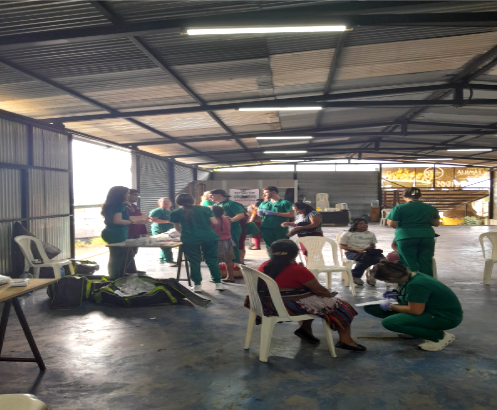
The van leaves the cobble stone streets of Antigua and takes the road to the Guatemalan highlands. The van takes minds and hearts willing to learn while serving. While the mountains surround the way ahead, the song Bohemian Rhapsody is playing in the background, the need to take basic medical care to underserved rural communities is a daily discussion.

Upon arrival, women and children wait with expectation and hope. What is coming inside the vans? The physician assistant students and doctors, that is what you can see, but something else is also aboard: hope. Hope, care, love, and passion arrive. Because, in the end, health care goes beyond medications and stethoscopes. Normally, a medical mission lasts a week, what happens in those days could be difficult to describe precisely, but there are some things that deserve to be highlighted. One is the medical purpose, these communities have been forgotten and underserved for decades, so this would be an opportunity to have a doctor visit for the families, an opportunity to receive a deep care. From common diseases, chronic conditions, wherever the need leads us. The medical mission is a chance to learn of every experience, improving from one to the next one. Another is the psychosocial aspect; a medical mission is an opportunity for communities to be heard, to be comforted, to feel hope.

At the same time, from the other side, one of the Professors of the program highlighted that the medical missions are “such a deep experience that allows them to eye opening, to have a comprehensive understanding of health care at frontlines, but this is also an opportunity in which every student can test their personal capacities, limits, even things that they perhaps did not know they have.”
One of the students about to graduate from the program shared that “this is the second time that I have been in Guatemala, I am always surprised about the need for health care, and I enjoy and treasure being so close to each patient, to treat each as is deserved. I am not the same when I come back home, I see things differently.”
ASSADE’s Mission
Cultivate development of unprotected Mayan children and women through the construction of fundamental rights, establishing an inclusive and participatory context at the individual, family and community level where ideas and feelings flow, forming an oasis of wisdom as a catalyst for improving the quality of life based on a framework of humanism, respect and love.
About ASSADE
ASSADE is a grassroots, non-governmental organization that aims to bridge the gaps in healthcare quality and access among rural and Mayan populations in Guatemala. The organization provides a wide variety of services to community members, spanning gynecological and obstetric care, healthy child care, dental care, health education programs, pharmaceutical services, and so much more. Leading from its heart, the aims of ASSADE are three fold:
Dignifying the Right to Health and Education for Mayans
Ensure the right to receive comprehensive health care - curative and preventive - and education for vulnerable communities stricken by an exclusionary, discriminating and alienated system with interests that belittle life.
Health and Education Equity
Provide quality health care and education to all communities without any discrimination through integration of quality, respect, equity, equality, justice, inclusion, dignity, innovation, pertinence and passion.
Building capacity
Create participatory education through community synergy for health prevention and development, aimed to find new alternatives to solve problems. Build an alternative model of inclusive health care and school with indigenous communities based on participatory knowledge-management.
Connect With Us!
ASSADE
GlobeMed at UNC Chapel Hill
Stories and pictures by Julio Alberto Chávez Letona, Edited by Catherine Gorman, Distributed by GlobeMed at UNC Chapel Hill (November 2025)


Comments